
(© Sustainable Musicology)
Sustainable Musicology and Micro-Shifts: Michelangeli’s BruyèresApril 2026
The discovery was accidental, and for that very reason perhaps revealing. While playing Debussy’s Bruyères from memory, I suddenly became aware of what seemed, at first, a simple rhythmic mistake. The immediate reaction was predictable, almost automatic: how could it be that, after so many years at the piano, such a basic misreading had gone unnoticed? Yet the doubt that followed was of a different order. What if the error were not mine alone? What if it had been transmitted, silently, through listening—absorbed rather than learned? A quick check was enough to complicate matters. Listening again to Arturo Benedetti Michelangeli’s recording of the Préludes, one hears precisely the same inflection. Not an isolated deviation, but a consistent habit of execution. I had, in effect, been playing “like Michelangeli” without knowing it, and, more tellingly, without ever being corrected. At no point, not even during formal training, had this detail been singled out as problematic. Certain deformations, it would seem, once sufficiently persuasive, cease to appear as deformations at all. In the passage in question, Debussy writes a triplet of semiquavers, whose natural accent falls on the first note of the triplet. 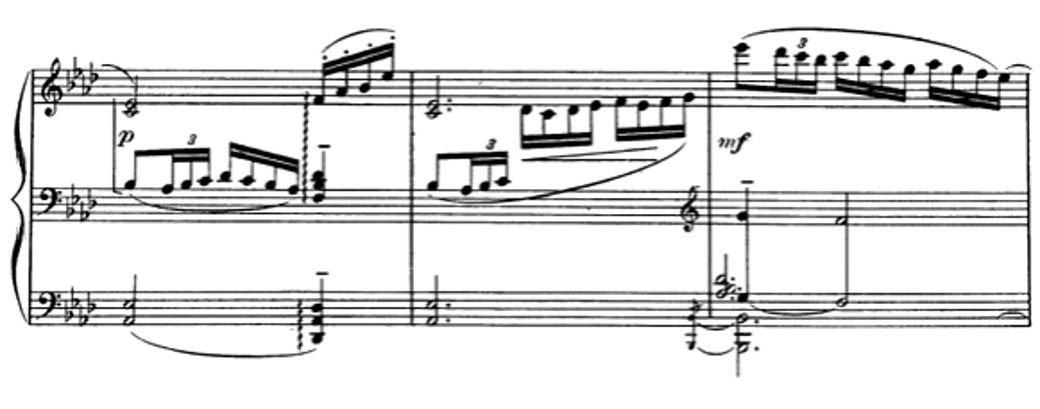
Example 1
Michelangeli, however, systematically reshapes the figure. The first note is absorbed into the previous gesture, while the accent shifts forward, settling on the second (see below Examples 2-3). The effect is delicate, but unmistakable. More importantly, it is coherent and repeated, not the result of momentary freedom. This is not an insignificant nuance. A few measures later, Debussy explicitly notates a different figure (a group of four demisemiquavers with the first tied note), making it clear that the two configurations are not interchangeable. The distinction is not decorative, but structural. 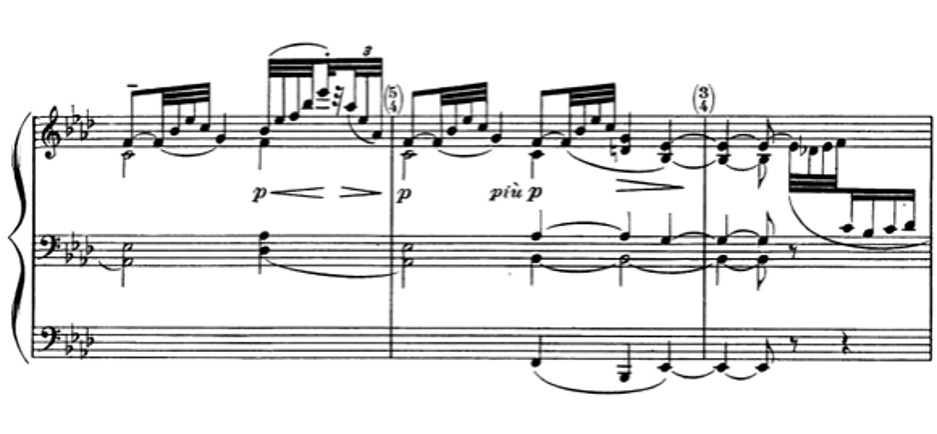
Example 2
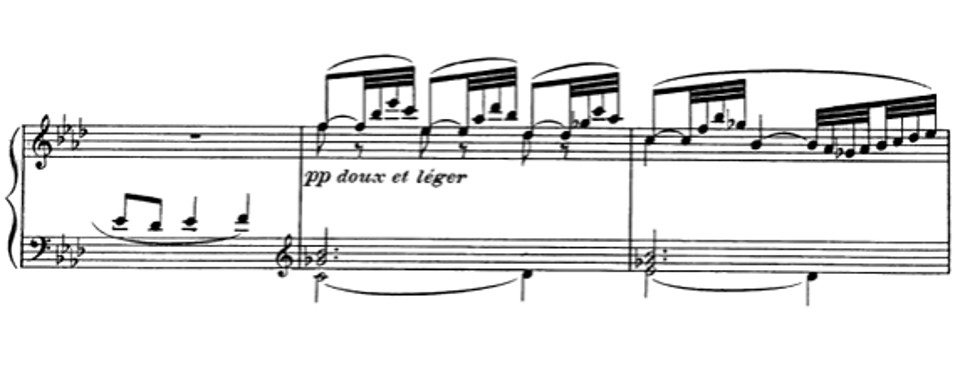
Example 3
What emerges, then, is not merely an interpretative liberty, but a subtle rewriting: one that might be defended in terms of rubato, yet remains, in essence, a displacement of the written rhythm. And this is where the question becomes more curious. How is it that such a phenomenon, at once audible and systematic, has attracted so little explicit attention in music criticism or musicological writing? Perhaps because it is, in a sense, too elementary. It does not lend itself to apparatus, nor does it generate projects or justify funding. One could imagine, instead, a far more elaborate enterprise: an international research initiative, complete with a suitably resonant acronym, devoted to the comprehensive computational analysis of Michelangeli’s recordings. Every note measured to the millisecond, every deviation translated into data, every nuance rendered as a graph. The outcome would be beyond reproach. A sophisticated digital platform, rarely visited; a database of considerable scale, destined to obsolescence; a printed volume of diagrams that even its author might not revisit after proofreading. Meanwhile, the musical question, the thing one actually hears, would remain, curiously, untouched. Or worse, obscured by a layer of familiar rhetoric: Michelangeli as the embodiment of “absolute rhythmic precision,” of “fidelity to the score,” of “surgical control.” Surgical, perhaps, but not necessarily on the right patient. If musicology is to retain a measure of relevance, if it is to be sustainable, it may need to recover a simpler gesture: to return to the score and to listen, without deference. Not in order to correct Michelangeli, which would be beside the point, but to recognize a more pervasive phenomenon: a form of selective deafness, in which what is heard gradually displaces what is written. For Michelangeli’s reading, however at odds with the notation, is undeniably effective. It persuades, it seduces, it establishes itself as authoritative. And this, in the end, is how traditions take shape: not from the text alone, but from what convinces the ear. Something shifts, almost imperceptibly. The score remains fixed, but listening moves elsewhere. At a certain point, one is no longer reading Debussy, but Debussy as filtered through Michelangeli: a subtle but consequential transformation. A sustainable musicology, one might say, begins with the recognition of this gap: between what is written and what we have learned to hear. The two, as it turns out, do not always coincide. |